プロジェクト趣意書 2020
『東京画』 TOKYO-GA
Describing Tokyo Scapes by 100 photographers
In spring 2011, we experienced the gigantic East Japan earthquake, one of the biggest tragedies of our country that will remain in the memory of people for generations. The tremendous earthquake, the enormous tsunami and the catastrophic meltdown of the Fukushima power plant, all three incidents have damaged heavily the beautiful Japanese landscape and the trust in a safe Japanese nation. The memory of it all makes us dread the future.
Especially the third tragedy, the meltdown of the Fukushima nuclear plant - built for the power supply of Tokyo - has bestowed a guilty conscience on the residents of the metropolitan area. Now, we feel keenly our ignorance of the problems and burdens that went with the preservation of the status and the functioning of greater Tokyo.
Time passing, Tokyo was chosen to become host for the 2020 Olympics. This upcoming event will be an opportunity for us to show the new Japan that has arisen from the huge 2011 Earthquake to the world. Indeed, we now live in a special era of reasoning that gives rise to a more critical mind and new existential values.
"TOKYO-GA" gathers photographs taken by 100 photographers who have chosen Tokyo as their subject. Through the perspective of these photographers, "Tokyo-Ga" wants to promote reflection on the development of our city: where should we be headed for? By looking at the works, we want people to ponder over what is beautiful, what is sad, what is important, and to evaluate the possibilities that may lie ahead.
Instead, we wish to share the beat and breath of Tokyo, a city undergoing big changes in this decade, and to witness the presence with sincerity by accumulating the facts of what is happening around us.
The works illustrated in "TOKYO-GA" show us some aspects of what is essential for Tokyo, something fragile such as an atmosphere, a behavior or a gesture. But in order for photography to earn public trust and approval, it has to choose the facts of life carefully. We want to give proof of the facts by showing 100 photographers who have each of them identified Tokyo in their own personal way.
Naoko OHTA
Founder
TOKYO-GA
2011年春、私たちは「東日本大震災」という名で後世も記憶される未曾有の大惨事を体験しました。巨大地震、巨大津波、そして福島原子力発電所のメルトダウン、山紫水明という言葉で表現される美しい国土と安心、安全をキーワードにしてきた日本にとって、それはとてつもなく大きなダメージと未来への不安として脳裏に刻まれた出来事でした。
特に、三つ目の惨事の現場となった原子力発電所は東京という大都市のエネルギー供給のために設置された施設であったという事実、"都会という不毛の土地"に住む者に理屈ではない罪悪感として重くのしかかってきたのです。
首都、東京がその立場や機能を維持するために派生しているさまざまな現実に私たちがいかに無関心、無知であったかを痛感させられました。
あれから歳月が流れ、2020年、二度目となるオリンピックの開催が決定しました。来るべき東京オリンピックは、2011年の大震災から再生した新たな日本の姿を世界に向かって高らかに謳うシーンとなるはずです。つまり、このディケード(十年)は東京がまさに新しい存在理由と価値を構築する過程となる特別な時代でもあるのです。
『東京画』はこの特別な時代を、100人の写真家が東京を被写体とした作品をアーカイブすると同時に、彼らの眼差しを通して、東京が歩むべき道をリアルタイムで同時代の人々と共に考えてゆく鮮度の高い発信活動を目的としています。
今、東京で何を問題点として自覚し、何を美しいと判断し、何を悲しく想い、何を大切だと感じ、そしてどんな可能性が見えているか、写真として提示したいと思うのです。
この十年間、大きく変貌を遂げようとする東京という都市の鼓動と呼吸を共に感じ、ひらすら真摯に「今という時間」に向き合い、ここで起こる事実を積み重ねてゆきたいと願っています。
「東京画」で描き出されるもの、それは東京という場所が持つ"気配"、"ふるまい"、"しぐさ"のように儚いものかもしれません。ただ、写真が写真として社会の信頼や共感を未来も勝ち得て行くには、「確かに生きた」というささやかな事実をどれだけ丁寧に拾い上げてゆくかにかかっているのではないかと思うのです。
そしてその事実を、「東京」を識別できる100人の写真家による写真で証明したいと念じています。
太田 菜穂子
ファウンダー
| キュレーターズ・オフィス |
太田菜穂子 チーフキュレーター
藤木洋介 キュレーター
| ディレクターズ・ボード |
太田 菜穂子
杉山 恒太郎
田中 正人
ギュンター・ツォーン
| コラボレイティブ・クリエイター |
山口 誠 / 建築家
柿木原 政広 / アートディレクター
下田 夏絵 / ウェブ・デザイナー
| 事務局 |
池末 浩規
『東京画』に寄せられたメッセージ
I expect Tokyo-Scapes to communicate the exquisite charm, power, and vibrations of the Tokyo Megalopolis, which other sceneries, urban landscapes, a succession of vertical and horizontal rhythmical symphonies, which no other city in the world can give.
世界中のどの街にもない風景、都市の情景、
垂直と水平のリズミカルなシンフォニーを奏でる東京メガロポリス。
その絶妙な魅力、パワーとヴァイブレーションを「東京画」は見事に表現してくれることでしょう。
The future may penetrate into the present time and space gradually, without showing its overwhelming scale or definite shape.
The Tokyo metropolitan city may be the one where the future easily comes in and stays for a while. Tokyo offers city spaces where buildings may not show their existence, and its scenes include the phenomenon of the colour and the shape of the air. We breathe the air of future in this city day by day, and we are tinged with its colour unconsciously.
The images of TOKYO-GA remind me of the generosity of Tokyo which seems to receive the future gently. The landscapes I saw in my childhood was enrobed by such generous air.
TOKYO-GA, the project describing the present and the future of Tokyo by photography, it is a marvelous project for those who love to support Tokyo, like myself.
おそらく未来とは、圧倒的なスケールや明解なかたちをもってではなく、ごく少しずつ、だが確実に、現在に、この現実の空間に入り込んでくるものに違いない。
中でもこの未来が最も入り込みやすい場所、居つきやすい空間が、東京という街なのではないだろうか。
建物はそこに建っているにもかかわらず、無いようにも見え、空気のひとつの形、色、現象としての風景が存在する都市空間。僕たちは知らず知らずのうちに、毎日少しずつ未来の空気を吸い、その色に染まっていっている。「東京画」の写真を見るとき、僕たちははっと気づく。こうやって優しく未来を受け入れる東京の寛大さに。そう言えば、自分が小さいころ見ていた東京の風景も、同じような優しい空気に包まれていた。写真が切り取る東京の今と未来。「東京画」、東京を応援したい僕たちにとって素晴らしい企画です。
優れた感性と卓越した技術を持つ100人の写真家が、躍動する東京の多様な姿、
かたち、魅力、ライフスタイルを写し取り世界に向けて発信する「東京画」。
本プロジェクトは、世界を引きつけてやまない普遍的な価値となる可能性を秘めています。
東京画は東京の意味を書き変える、輝く希望の光となるでしょう。
♦プロジェクトの目的 / Our Aim
「東京画」は写真を介在にしたアートプロジェクトです。
国内外100人の写真家による「東京画」を通じて、
「東京」という街について、またそこに関わる私たち自身について考え、共有し、
新たな価値の発見やビジョンを伴った次のアクションとムーブメントを引き起こすことを目的にしています。
"TOKYO-GA" is an extensive art project that unites 100 Japanese and international photographers and their individual perception of Tokyo's grand picture. The purpose of this project is to reflect upon future actions and movements while considering what we have, who we are and what we discover in the process.
♦なぜ「東京」なのか / Why Tokyo?
世界中の多くの地図において、その右端に位置する日本。
欧米諸国から日本はかつて「極東(Far East)」と呼ばれ、そのレイアウトと同じく、
世界文明の"行き止まり"の国であると認識されてきました。
多方向から常に新しい文物が押し寄せる中継地ではなく、最後にとどまる場所に位置するゆえに丁寧に磨き上げることができた日本人の特性は、 さまざまな"道"へと昇華され、精神性と技術力が一体化した"生きる姿勢"となり、現在もさまざまな分野で継承されています。
近年までの海外からの日本への評価は、その歴史や伝統と共に先端をゆく多様なトレンドや異文化を共存させるその柔軟性が相まって、
"ミステリアスな可能性"であり続けることができました。
しかし、日本のミステリアスな魅力はそのユニークネスゆえに、ガラパゴス化と揶揄される実状があります。
私たちが未来の世界時間の中で、日本の首都「東京」の存在価値を探っていくとしたら。
多様に行き交うコミュニケーションを視覚化し、広くパブリックな場で提示することから始めるべきだと考えます。
自分たちの拠り所である"居場所"の未来と向き合う時、「東京」の未来を具体的に俯瞰し、
話をしてみることは昨年の大震災を経験した今だからこそ、私たちが取り組むアクションなのではないでしょうか?
100人の写真家たちが捉えた東京を巡る多様な写真絵巻は、未来と向き合うコミュニケーションの出発点となるはずです。
On the world map of many countries, Japan is situated at the right end corner. Situated in the so-called Far East, Japan has often been considered as a dead end rather than a relay point or crossroads of new civilizations.
This is why the essence of what is Japanese has been carefully developed within the borders of our own motherland. Spiritually and technically, our qualities have been refined to propose each a different way of life in various fields.
Japanese people keep tradition and history very much alive but are quite flexible when confronted with different cultures and new trends. Thus Japan has always appeared as rather mysterious to other countries.
But with such a mysterious charm, we risk to enhance Japan's isolation. If we are to search for the "raison d'être" of our capital Tokyo in the world's future, we will have to explain clearly the way of our communication and facilitate access and understanding for large publics.
Just after the painful experience of the TOHOKU disaster on March 11, 2011, we need a clear vision of Tokyo's future, the city we live in and rely upon. As well, we need to think carefully about the actions to be taken from now on.
♦なぜ「写真」なのか? / Why Photography?
写真には力があります / Photography has power
写真家の私的な関心に過ぎなかった、一枚、もしくは複数の写真が社会に提示されたとき、
その写真は個人的な思いや記録から、社会にとっての必然性を備えたメディアとしての力を持ち、
それはコミュニケーションの起点となることができます。
そこに生じる「写真の力」、
それは写真表現の独自性の中に潜んでいるようです。
Once photography of a personal interest is released to the public, it is no longer a personal or emotional memory. Such photography can initiate communication and attain the power of a media in service of society. The power of photography accomplished in such a way, has its origin in the uniqueness of photographic expression.
写真は「コミュニケーション」です / The photography can communicate
写真は、言語を必要としないダイレクトに伝わるコミュニケーション力を備えています。
言葉にはない圧倒的なスピードで見る人を共通の磁場へ引き上げる写真の力、
写真を見て、共有するところから生まれるコミュニケーションは圧倒的に質の高いものとなるはずです。
The photography has the power of direct communication without using words.
It has the power to elevate people to different level of shared values and understanding. Communication given and shared by photography can be of high quality when the audience shares the same evidences and emotions.
写真は「他人を信じる力」です / The photography can give trust to other people
写真は非常にユニークな視覚表現と言えます。
写真家が自身の目(フォトグラファーズアイ)で見たものを、
カメラという機械の目(カメラアイ)で写し取り、
それをさらにその写真を見る第三の目で認識されるのです。
つまり、"写真を見る"ということは自分以外の目を信じることを前提に、
そこからはじまっているのです。
The photography is a very unique means of visual expression.
The object viewed by the photographer's eyes is mechanically photographed by the camera's eye, and finally seen by a third person's eyes. So "looking at a photography" starts with the feeling of trust in somebody else's eyes.
写真は「存在」を写します / The photography reproduces "the existence"
目に見えるモノやコト、実在したある事実が写真には写ります。
しかし、その事実をどう捉えるのか、それは見る人の見方によって異なります。
私たちは写真に写っている、目に見える情報以上の情報を受け取り、それを視覚として認識するのです。
The photography reproduces what we see in existence, however, everybody can feel freely on what he sees.
We can visually receive more information than what we seem to see on the photography and beware of this fact.
写真は常に「未来」に向かっています / The photography can connect with the future
写真に写っているものは常に過去に存在した事象に他なりません。
しかし、「撮る」「写る」「作る」「見る」といった一連の写真行為は
その時点から先の未来へ向けた投げかけです。
In photography, we see what existed in the past and this existence can provoke questions on the future:
throughout the process of photography as for the choice of the object, the reproduction of reality, the creation of a composition and the final result.
私たちはそうした「写真の力」を通して、
個人的な思いを他人と共有する、他人の考えを自分の心の中に落としてみる、
そうしたコミュニケーションの上、自身のこと、世界のことについて考えてみたいと思うのです。
We would like to reflect on ourselves, our world and future through the communication given to us by photography.
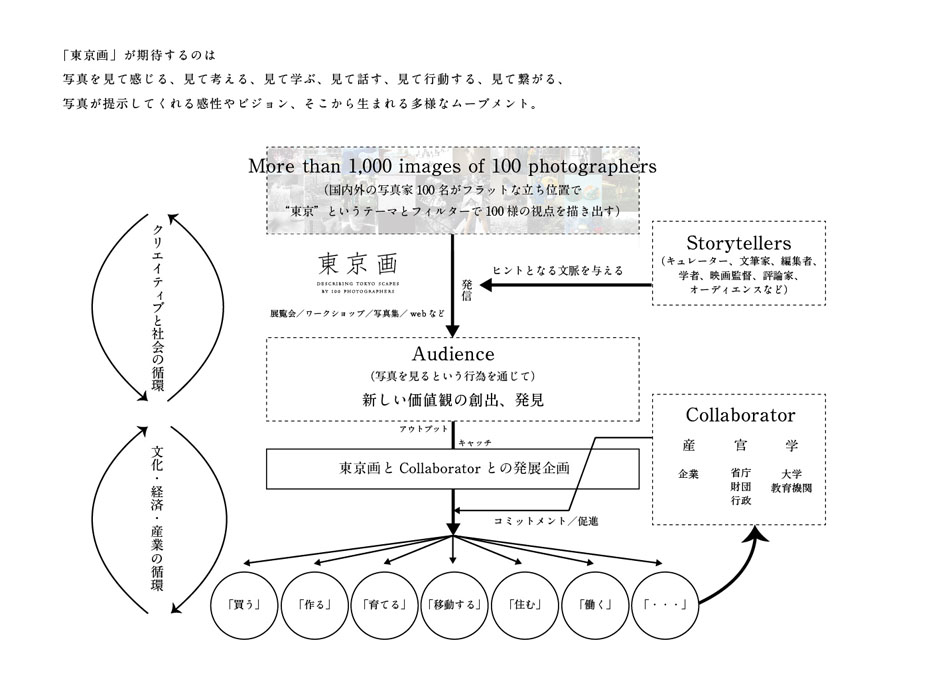
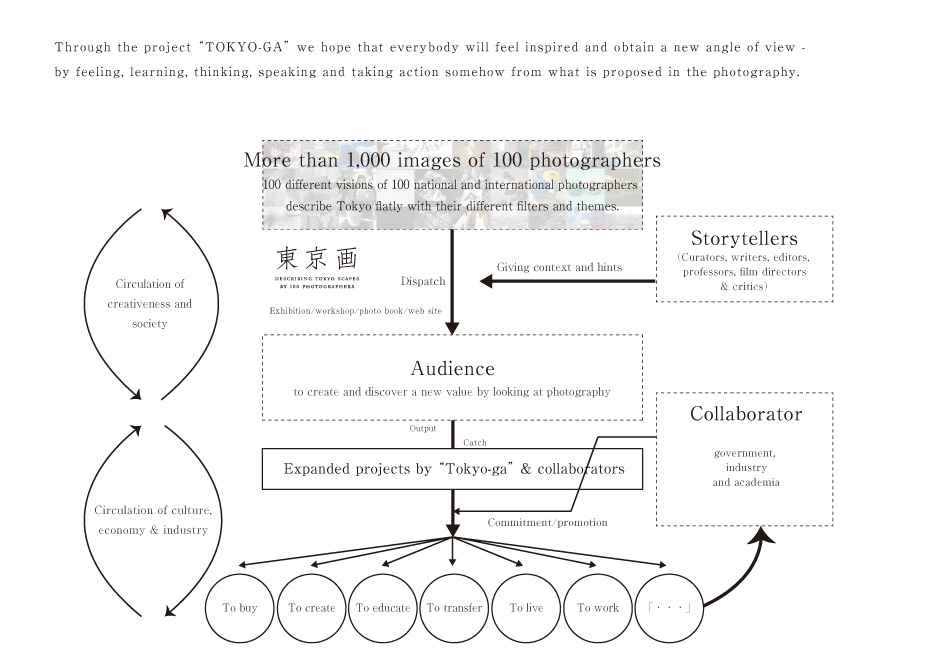
♦プロジェクトマッピング / Project map - communication diagram
「東京画」が期待するのは
写真を見て感じる、見て考える、見て学ぶ、見て話す、見て行動する、見て繋がる、
写真が提示してくれる感性やビジョン、そこから生まれる多様なムーブメント。
Through the project "TOKYO-GA" we hope that everybody will feel inspired and obtain a new angle of view - by feeling, learning, thinking, speaking and taking action somehow from what is proposed in the photography.
プロジェクトについてのお問い合わせおよび取材の申し込みは、下記までお寄せください。
Further information to:
TOKYO-GA committee c/o KLEE INC.
〒107-0052 東京都港区赤坂8-12-25 ミルーム乃木坂401号
8-12-25-401, Akasaka, Minato-ku, Tokyo 107-0052 JAPAN
Tel. 03-5410-1277 / Fax. 03-5410-1278 / Email. info@klee.co.jp
[Project]
100 Photographers
Commissioner's Board
- Tokyo / Headquarters -
| Curator office |
Naoko OHTA (Chief Curator / Commissioner)
Yosuke FUJIKI (Associate Curator)
| Director's Board |
Naoko OHTA (Founder / Chairperson)
Kotaro SUGIYAMA (Executive Creative Director)
Masato TANAKA (Doctor of Engineering, Professor of the Tokyo University)
Guenter Zorn (Representative Director / President z-anshin K.K.)
| Collaborative Creators |
Makoto YAMAGUCHI (Architect)
Masahiro KAKINOKIHARA (Art Director)
Natsue SHIMODA (Web Designer)
| Administration |
Hiroki IKESUE
『東京画』 TOKYO-GA
Describing Tokyo Scapes by 100 photographers
In spring 2011, we experienced the gigantic East Japan earthquake, one of the biggest tragedies of our country that will remain in the memory of people for generations. The tremendous earthquake, the enormous tsunami and the catastrophic meltdown of the Fukushima power plant, all three incidents have damaged heavily the beautiful Japanese landscape and the trust in a safe Japanese nation. The memory of it all makes us dread the future.
Especially the third tragedy, the meltdown of the Fukushima nuclear plant - built for the power supply of Tokyo - has bestowed a guilty conscience on the residents of the metropolitan area. Now, we feel keenly our ignorance of the problems and burdens that went with the preservation of the status and the functioning of greater Tokyo.
Time passing, Tokyo was chosen to become host for the 2020 Olympics. This upcoming event will be an opportunity for us to show the new Japan that has arisen from the huge 2011 Earthquake to the world. Indeed, we now live in a special era of reasoning that gives rise to a more critical mind and new existential values.
"TOKYO-GA" gathers photographs taken by 100 photographers who have chosen Tokyo as their subject. Through the perspective of these photographers, "Tokyo-Ga" wants to promote reflection on the development of our city: where should we be headed for? By looking at the works, we want people to ponder over what is beautiful, what is sad, what is important, and to evaluate the possibilities that may lie ahead.
Instead, we wish to share the beat and breath of Tokyo, a city undergoing big changes in this decade, and to witness the presence with sincerity by accumulating the facts of what is happening around us.
The works illustrated in "TOKYO-GA" show us some aspects of what is essential for Tokyo, something fragile such as an atmosphere, a behavior or a gesture. But in order for photography to earn public trust and approval, it has to choose the facts of life carefully. We want to give proof of the facts by showing 100 photographers who have each of them identified Tokyo in their own personal way.
Naoko OHTA
Founder
TOKYO-GA
2011年春、私たちは「東日本大震災」という名で後世も記憶される未曾有の大惨事を体験しました。巨大地震、巨大津波、そして福島原子力発電所のメルトダウン、山紫水明という言葉で表現される美しい国土と安心、安全をキーワードにしてきた日本にとって、それはとてつもなく大きなダメージと未来への不安として脳裏に刻まれた出来事でした。
特に、三つ目の惨事の現場となった原子力発電所は東京という大都市のエネルギー供給のために設置された施設であったという事実、"都会という不毛の土地"に住む者に理屈ではない罪悪感として重くのしかかってきたのです。
首都、東京がその立場や機能を維持するために派生しているさまざまな現実に私たちがいかに無関心、無知であったかを痛感させられました。
あれから歳月が流れ、2020年、二度目となるオリンピックの開催が決定しました。来るべき東京オリンピックは、2011年の大震災から再生した新たな日本の姿を世界に向かって高らかに謳うシーンとなるはずです。つまり、このディケード(十年)は東京がまさに新しい存在理由と価値を構築する過程となる特別な時代でもあるのです。
『東京画』はこの特別な時代を、100人の写真家が東京を被写体とした作品をアーカイブすると同時に、彼らの眼差しを通して、東京が歩むべき道をリアルタイムで同時代の人々と共に考えてゆく鮮度の高い発信活動を目的としています。
今、東京で何を問題点として自覚し、何を美しいと判断し、何を悲しく想い、何を大切だと感じ、そしてどんな可能性が見えているか、写真として提示したいと思うのです。
この十年間、大きく変貌を遂げようとする東京という都市の鼓動と呼吸を共に感じ、ひらすら真摯に「今という時間」に向き合い、ここで起こる事実を積み重ねてゆきたいと願っています。
「東京画」で描き出されるもの、それは東京という場所が持つ"気配"、"ふるまい"、"しぐさ"のように儚いものかもしれません。ただ、写真が写真として社会の信頼や共感を未来も勝ち得て行くには、「確かに生きた」というささやかな事実をどれだけ丁寧に拾い上げてゆくかにかかっているのではないかと思うのです。
そしてその事実を、「東京」を識別できる100人の写真家による写真で証明したいと念じています。
太田 菜穂子
ファウンダー
| キュレーターズ・オフィス |
太田菜穂子 チーフキュレーター
藤木洋介 キュレーター
| ディレクターズ・ボード |
太田 菜穂子
杉山 恒太郎
田中 正人
ギュンター・ツォーン
| コラボレイティブ・クリエイター |
山口 誠 / 建築家
柿木原 政広 / アートディレクター
下田 夏絵 / ウェブ・デザイナー
| 事務局 |
池末 浩規
『東京画』に寄せられたメッセージ
I expect Tokyo-Scapes to communicate the exquisite charm, power, and vibrations of the Tokyo Megalopolis, which other sceneries, urban landscapes, a succession of vertical and horizontal rhythmical symphonies, which no other city in the world can give.
世界中のどの街にもない風景、都市の情景、
垂直と水平のリズミカルなシンフォニーを奏でる東京メガロポリス。
その絶妙な魅力、パワーとヴァイブレーションを「東京画」は見事に表現してくれることでしょう。
Richard COLLASSE
Chairman, CHANEL.K.K.
リシャール・コラス
シャネル株式会社取締役会長
Chairman, CHANEL.K.K.
リシャール・コラス
シャネル株式会社取締役会長
The future may penetrate into the present time and space gradually, without showing its overwhelming scale or definite shape.
The Tokyo metropolitan city may be the one where the future easily comes in and stays for a while. Tokyo offers city spaces where buildings may not show their existence, and its scenes include the phenomenon of the colour and the shape of the air. We breathe the air of future in this city day by day, and we are tinged with its colour unconsciously.
The images of TOKYO-GA remind me of the generosity of Tokyo which seems to receive the future gently. The landscapes I saw in my childhood was enrobed by such generous air.
TOKYO-GA, the project describing the present and the future of Tokyo by photography, it is a marvelous project for those who love to support Tokyo, like myself.
おそらく未来とは、圧倒的なスケールや明解なかたちをもってではなく、ごく少しずつ、だが確実に、現在に、この現実の空間に入り込んでくるものに違いない。
中でもこの未来が最も入り込みやすい場所、居つきやすい空間が、東京という街なのではないだろうか。
建物はそこに建っているにもかかわらず、無いようにも見え、空気のひとつの形、色、現象としての風景が存在する都市空間。僕たちは知らず知らずのうちに、毎日少しずつ未来の空気を吸い、その色に染まっていっている。「東京画」の写真を見るとき、僕たちははっと気づく。こうやって優しく未来を受け入れる東京の寛大さに。そう言えば、自分が小さいころ見ていた東京の風景も、同じような優しい空気に包まれていた。写真が切り取る東京の今と未来。「東京画」、東京を応援したい僕たちにとって素晴らしい企画です。
Mineaki SAITO
Representative, Scenery International,
齋藤峰明
シナリーインターナショナル 代表
Representative, Scenery International,
齋藤峰明
シナリーインターナショナル 代表
優れた感性と卓越した技術を持つ100人の写真家が、躍動する東京の多様な姿、
かたち、魅力、ライフスタイルを写し取り世界に向けて発信する「東京画」。
本プロジェクトは、世界を引きつけてやまない普遍的な価値となる可能性を秘めています。
東京画は東京の意味を書き変える、輝く希望の光となるでしょう。
Masato TANAKA (Doctor of Engineering, Professor of the Tokyo University)
Doctor of Engineering
Honorary professor, The University of Tokyo
田中正人
工学博士/東京大学名誉教授
Doctor of Engineering
Honorary professor, The University of Tokyo
田中正人
工学博士/東京大学名誉教授
♦プロジェクトの目的 / Our Aim
「東京画」は写真を介在にしたアートプロジェクトです。
国内外100人の写真家による「東京画」を通じて、
「東京」という街について、またそこに関わる私たち自身について考え、共有し、
新たな価値の発見やビジョンを伴った次のアクションとムーブメントを引き起こすことを目的にしています。
"TOKYO-GA" is an extensive art project that unites 100 Japanese and international photographers and their individual perception of Tokyo's grand picture. The purpose of this project is to reflect upon future actions and movements while considering what we have, who we are and what we discover in the process.
♦なぜ「東京」なのか / Why Tokyo?
世界中の多くの地図において、その右端に位置する日本。
欧米諸国から日本はかつて「極東(Far East)」と呼ばれ、そのレイアウトと同じく、
世界文明の"行き止まり"の国であると認識されてきました。
多方向から常に新しい文物が押し寄せる中継地ではなく、最後にとどまる場所に位置するゆえに丁寧に磨き上げることができた日本人の特性は、 さまざまな"道"へと昇華され、精神性と技術力が一体化した"生きる姿勢"となり、現在もさまざまな分野で継承されています。
近年までの海外からの日本への評価は、その歴史や伝統と共に先端をゆく多様なトレンドや異文化を共存させるその柔軟性が相まって、
"ミステリアスな可能性"であり続けることができました。
しかし、日本のミステリアスな魅力はそのユニークネスゆえに、ガラパゴス化と揶揄される実状があります。
私たちが未来の世界時間の中で、日本の首都「東京」の存在価値を探っていくとしたら。
多様に行き交うコミュニケーションを視覚化し、広くパブリックな場で提示することから始めるべきだと考えます。
自分たちの拠り所である"居場所"の未来と向き合う時、「東京」の未来を具体的に俯瞰し、
話をしてみることは昨年の大震災を経験した今だからこそ、私たちが取り組むアクションなのではないでしょうか?
100人の写真家たちが捉えた東京を巡る多様な写真絵巻は、未来と向き合うコミュニケーションの出発点となるはずです。
On the world map of many countries, Japan is situated at the right end corner. Situated in the so-called Far East, Japan has often been considered as a dead end rather than a relay point or crossroads of new civilizations.
This is why the essence of what is Japanese has been carefully developed within the borders of our own motherland. Spiritually and technically, our qualities have been refined to propose each a different way of life in various fields.
Japanese people keep tradition and history very much alive but are quite flexible when confronted with different cultures and new trends. Thus Japan has always appeared as rather mysterious to other countries.
But with such a mysterious charm, we risk to enhance Japan's isolation. If we are to search for the "raison d'être" of our capital Tokyo in the world's future, we will have to explain clearly the way of our communication and facilitate access and understanding for large publics.
Just after the painful experience of the TOHOKU disaster on March 11, 2011, we need a clear vision of Tokyo's future, the city we live in and rely upon. As well, we need to think carefully about the actions to be taken from now on.
♦なぜ「写真」なのか? / Why Photography?
写真には力があります / Photography has power
写真家の私的な関心に過ぎなかった、一枚、もしくは複数の写真が社会に提示されたとき、
その写真は個人的な思いや記録から、社会にとっての必然性を備えたメディアとしての力を持ち、
それはコミュニケーションの起点となることができます。
そこに生じる「写真の力」、
それは写真表現の独自性の中に潜んでいるようです。
Once photography of a personal interest is released to the public, it is no longer a personal or emotional memory. Such photography can initiate communication and attain the power of a media in service of society. The power of photography accomplished in such a way, has its origin in the uniqueness of photographic expression.
写真は「コミュニケーション」です / The photography can communicate
写真は、言語を必要としないダイレクトに伝わるコミュニケーション力を備えています。
言葉にはない圧倒的なスピードで見る人を共通の磁場へ引き上げる写真の力、
写真を見て、共有するところから生まれるコミュニケーションは圧倒的に質の高いものとなるはずです。
The photography has the power of direct communication without using words.
It has the power to elevate people to different level of shared values and understanding. Communication given and shared by photography can be of high quality when the audience shares the same evidences and emotions.
写真は「他人を信じる力」です / The photography can give trust to other people
写真は非常にユニークな視覚表現と言えます。
写真家が自身の目(フォトグラファーズアイ)で見たものを、
カメラという機械の目(カメラアイ)で写し取り、
それをさらにその写真を見る第三の目で認識されるのです。
つまり、"写真を見る"ということは自分以外の目を信じることを前提に、
そこからはじまっているのです。
The photography is a very unique means of visual expression.
The object viewed by the photographer's eyes is mechanically photographed by the camera's eye, and finally seen by a third person's eyes. So "looking at a photography" starts with the feeling of trust in somebody else's eyes.
写真は「存在」を写します / The photography reproduces "the existence"
目に見えるモノやコト、実在したある事実が写真には写ります。
しかし、その事実をどう捉えるのか、それは見る人の見方によって異なります。
私たちは写真に写っている、目に見える情報以上の情報を受け取り、それを視覚として認識するのです。
The photography reproduces what we see in existence, however, everybody can feel freely on what he sees.
We can visually receive more information than what we seem to see on the photography and beware of this fact.
写真は常に「未来」に向かっています / The photography can connect with the future
写真に写っているものは常に過去に存在した事象に他なりません。
しかし、「撮る」「写る」「作る」「見る」といった一連の写真行為は
その時点から先の未来へ向けた投げかけです。
In photography, we see what existed in the past and this existence can provoke questions on the future:
throughout the process of photography as for the choice of the object, the reproduction of reality, the creation of a composition and the final result.
私たちはそうした「写真の力」を通して、
個人的な思いを他人と共有する、他人の考えを自分の心の中に落としてみる、
そうしたコミュニケーションの上、自身のこと、世界のことについて考えてみたいと思うのです。
We would like to reflect on ourselves, our world and future through the communication given to us by photography.
♦プロジェクトマッピング / Project map - communication diagram
「東京画」が期待するのは
写真を見て感じる、見て考える、見て学ぶ、見て話す、見て行動する、見て繋がる、
写真が提示してくれる感性やビジョン、そこから生まれる多様なムーブメント。
Through the project "TOKYO-GA" we hope that everybody will feel inspired and obtain a new angle of view - by feeling, learning, thinking, speaking and taking action somehow from what is proposed in the photography.
プロジェクトについてのお問い合わせおよび取材の申し込みは、下記までお寄せください。
Further information to:
TOKYO-GA committee c/o KLEE INC.
〒107-0052 東京都港区赤坂8-12-25 ミルーム乃木坂401号
8-12-25-401, Akasaka, Minato-ku, Tokyo 107-0052 JAPAN
Tel. 03-5410-1277 / Fax. 03-5410-1278 / Email. info@klee.co.jp
[Project]
100 Photographers
Commissioner's Board
- Tokyo / Headquarters -
| Curator office |
Naoko OHTA (Chief Curator / Commissioner)
Yosuke FUJIKI (Associate Curator)
| Director's Board |
Naoko OHTA (Founder / Chairperson)
Kotaro SUGIYAMA (Executive Creative Director)
Masato TANAKA (Doctor of Engineering, Professor of the Tokyo University)
Guenter Zorn (Representative Director / President z-anshin K.K.)
| Collaborative Creators |
Makoto YAMAGUCHI (Architect)
Masahiro KAKINOKIHARA (Art Director)
Natsue SHIMODA (Web Designer)
| Administration |
Hiroki IKESUE